 07
Oct
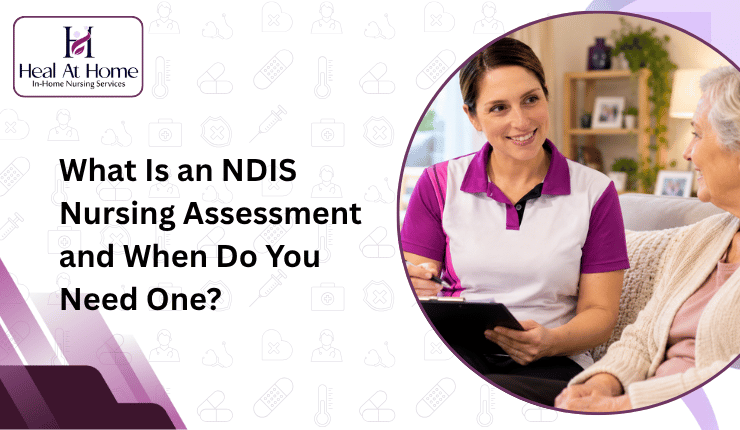
NDIS can sometimes appear difficult to understand, particularly when there is the need for supports in relation to complicated health requirements or care needs. The NDIS nursing assessment can be used to establish the impact of a person’s disability on his/her health, safety, and ability to perform tasks of daily living.
The NDIS nursing assessment can be quite helpful in providing information for disability-specific health supports. It is essential, however, to keep in mind that the NDIS nursing assessment is not a routine physical examination nor functional capacity assessment.
Let’s break down What is an NDIS nursing assessment, and when do you need one?
What Is an NDIS Nursing Assessment?
NDIS nursing assessments are conducted by qualified nurses for determining the health-related needs of participants due to their disabilities.
These can include issues related to:
- Personal care
- Continence needs
- Wound management
- Respiratory support
- Diabetes management
- Feeding & Nutrition
- Seizure management
The NDIS can fund health supports related to disability if they are directly related to the disability of individuals and adhere to NDIS guidelines.
Only a diagnosis is not enough to tell the whole picture. Good evidence explains how the disability affects daily life and what kind of help is actually needed.
What Does an NDIS Nursing Assessment Cover?
Every assessment looks a little different, depending on the person and the support being requested.
Typical considerations for a nurse include:
Healthcare needs
Care needs
Medication needs
Continence care
Pressure care
Nutritional needs
Respiratory care
Seizures
Supervision needs
Safety needs
Frequency of support
Need for carer training
For example, a patient with restricted mobility may require assistance with pressure care or continence care. A nursing assessment sets out exactly what’s needed, how often, and why it connects back to their disability.
The NDIS expects evidence to be recent, relevant, and specific to the individual, not generic or outdated.
When Do You Need an NDIS Nursing Assessment?
Not every participant needs one. It is generally applicable in certain particular circumstances.
1. You Need Disability-Related Health Supports
The NDIS may pay for some health supports where there is a clear link to the participant’s disability.
Common examples:
- Dysphagia support
- Diabetes management
- Continence care
- Wound care
- Respiratory support
- Seizure management
These must meet NDIS funding rules. General medical treatment usually sits with the mainstream health system, not the NDIS.
2. Your Support Needs Have Changed
Health needs change over time. It is necessary to have an updated assessment to consider the changes in the conditions of the participants.
An individual who has become unable to perform personal care after their previous assessment could benefit from a new up-to-date evidence base.
3. You Need Evidence for a Support Request
The NDIS relies on evidence to understand disability impact. A strong report doesn’t just name a condition; it explains:
- What the person can do
- What they can’t do
- What help is needed
- How often it’s needed
NDIS Nursing Assessment vs Functional Capacity Assessment
These two are often mixed up, but they’re not the same thing.
A functional capacity assessment (FCA) looks broadly at how disability affects daily life across six areas:
- Communication
- Learning
- Mobility
- Self-care
- Self-management
- Social interaction
An NDIS nursing assessment is more specific; it zeroes in on clinical and health-related care needs.
Think of it this way: an FCA might assess whether someone can shower safely, while a nursing assessment looks at things like wound care or continence management.
Depending on your situation, you may need one or both.
How to Prepare for an NDIS Nursing Assessment
You don’t need to memorise your entire medical history. But a bit of prep goes a long way.
Prior to your assessment, write down:
- Tasks requiring assistance daily
- Frequency of assistance
- Any safety and health hazards
- Currently available equipment
- Assistance from family members and carers
- Changes in needs lately
- History of treatment
Be more specific. Do not write that “I need assistance with personal care” but rather say exactly where and how you require help.
This will provide a better insight into your daily routine for the nurse.
Common Mistakes to Avoid
Considering only the diagnosis – Not just the diagnosis but how it impacts everyday functioning is important.
Using outdated evidence – Out-of-date sources cannot be used to make decisions about what you need. Updated information will have more impact.
Skipping frequency details – Just saying that something is needed is not sufficient. You need to specify frequency and when.
Mixing up healthcare and NDIS supports – NDIS doesn’t usually provide services such as regular healthcare services, hospitals and medicines for other reasons except disability.
FAQs
Is an NDIS nursing assessment compulsory?
Not necessarily. It will depend on various factors and the type of service that is needed. It is usually helpful where professional information about health requirements is necessary.
Who can conduct an NDIS nursing assessment?
The NDIS nursing assessment is performed by a Registered Nurse who has experience working with disabled individuals.
Is NDIS nursing assessment useful for funding?
Yes, it can be used in the funding process to prove your medical requirements. But just because you have this document doesn’t mean you will be funded, as the process of funding depends on NDIS criteria.
Is NDIS nursing assessment the same as FCA?
No, they are not the same as FCA looks at general functional capacity whereas the nursing assessment assesses the individual’s health care requirements.
How often should it be updated?
There’s no fixed rule. Generally, it’s worth updating when support needs change or when current evidence is needed for an NDIS decision.
Conclusion
An NDIS nursing assessment can make a real difference when health needs are tied to a disability. It turns everyday challenges into clear, professional evidence covering the type, frequency, and level of support required.
The focus should always be on real-life impact, not just a diagnosis. In case you have any doubts about what is required, you should always ask your health care provider or NDIS provider.
For any questions about nursing requirements related to disability, feel free to contact Heal at Home.